
Step 3: Build Upon What’s Working
Let’s continue exploring the “Legacy in Motion” Six-Step Process that I use to build family business continuity plans. Not only does this process create a Continuity Plan, one that fosters good collaboration and integration with your existing advisors, it builds essential capabilities for you and your team. Human capabilities I refer to as the 4 C’s: Curiosity, Compassion, Collaboration and Courage. Professional capabilities like project management and execution, collaboration, leadership and group decision-making. This process will equip your team to have structured, intentional conversations … one meeting at a time.
It is this ONE THING makes EVERYTHING else your family business seem easier to manage and execute. How? By empowering you to have the conversations you know you need to have but are avoiding. The ones you are waiting for the just the right time to initiate, but that moment never seems to come. This process moves these into the “urgent and important” space from the “some day” space.
Imagine the possibilities for you, your family, your team and your business if everyone feels equipped to lean into these conversations.
{Refer to a past article here if you would like a refresher on the process and the successful outcomes}.
Legacy in Motion Process
Foundation: Values, the 4 C’s (Curiosity, Compassion, Courage, Collaboration
Enablers: Mindset (Growth & Ownership), Community and Self-awareness
Step 1: Awareness of the systems you operate in
Step 2: Discovery (Family | Business | Ownership)
Step 3: Build Upon What’s working – you are further along than you think!
Step 4: Embrace formality
Step 5: Build your team - internal / external
Step 6: Execute, Reflect, Refine and Repeat (loop back to Step 3)
Step 3: Build Upon What’s Working
Experience tells us that initiating large change projects within family business teams rarely goes smoothly and risks eroding relationships and engagement. Instead, sustainable changes and transformations happen in increments … small tweaks. And we begin by leveraging what might already be working.
Small tweaks create movement and progress … and movement supersedes confidence.
Here are a few examples of “tweaks” I am referring to:
A) Communicating /Collaborating Intentionally
We may find out that your team is actually pretty good at collaborating, generally trusts each other and has strong relationships. It is just that every time you meet, emotions get involved, things get heated and complex quickly, or the meetings go longer than planned and/or conversations don’t seem to lead anywhere.
Here are a few small, but vital tweaks you could make:
Increase the frequency of your meetings, but decrease the duration (i.e. commit to weekly or biweekly meetings, instead of “as needed” or “ad hoc”)
Rethink the time of day you are meeting - select times that people are at their best, and can be fully present, not distracted
Group your meeting agenda items by Family, Business or Ownership area. Mixing these topics is a recipe for complexity, competing priorities, indecision.
Is there an “empty chair” in your meetings? Often, meetings leave out perspectives of those that are impacted by the discussions. How could you include them, or bring in their perspectives early on?
Appoint someone to create an agenda and send it out in advance. The agenda includes a time limit for each topic. If there is no agenda, no meeting!
Require separate meetings for Operating items, Strategy items and Project updates
Be clear on who can add items to the agenda and when
Appoint someone to facilitate / moderate the meetings - for sensitive, high impact meetings, it is best to engage in an independent, objective facilitator
B) Create an Action Plan for special projects & build upon individual and team strengths
When I work with teams on this activity, they are always amazed at how quickly project ideas surface and the action plan comes together. You can feel the group’s energy shifting during the meeting. Something special happens when lingering projects are written down, discussed AND someone is assigned responsibly for seeing them through.
The best part of this exercise is that we build upon the individual and collective strengths identified during the Discovery (Step 2). Team members will naturally find time to work on this list as their interests, strengths and skills are being recognized and utilized. They feel seen and heard when asked to participate in projects they’ve thought about for a while and can help in their implementation.
Here are a few categories to help you create and prioritize these projects:
Current Projects: initiatives started but have had slow progress, or are stuck, lost in the whirlwind of other priorities
New projects under $5k: projects that will have an impact and may not require formal approval;
New projects over $5k that will make an impact and are waiting for someone to prepare and present a business case
New projects over $5k and are only waiting for final approval
Witnessing the momentum and engagement through this activity is one of the many joys I have in serving family businesses.
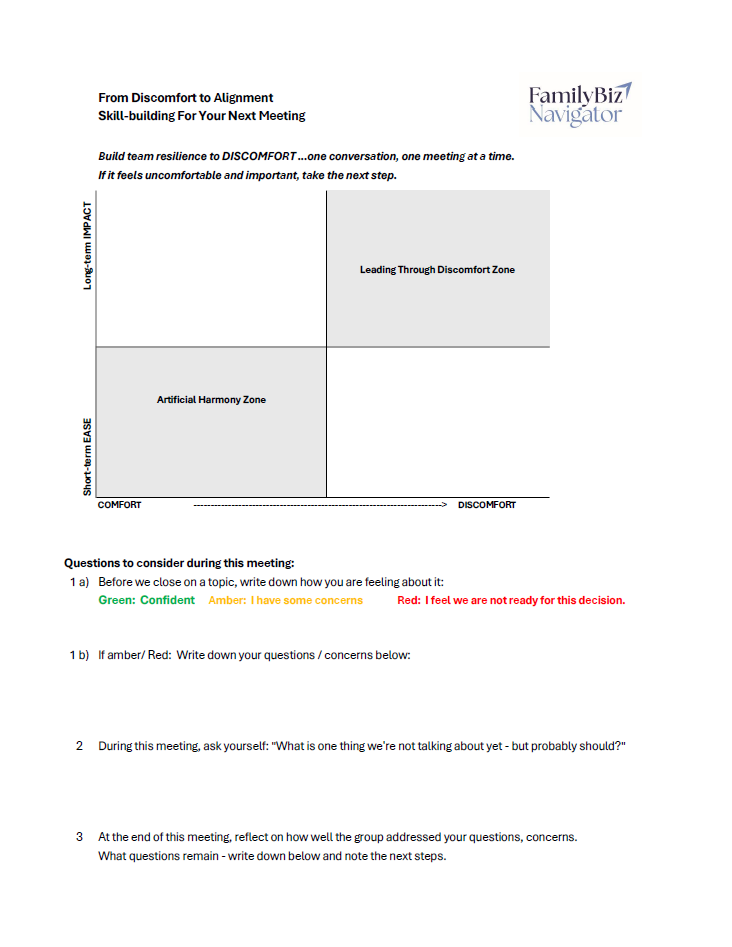
C) Introduce Skill-building into your Meetings
If it feels uncomfortable and important, chances are you are heading into an intentional conversation. One that has the potential to build alignment and give you greater clarity on something important. Below is an activity you can try during your next meeting. Reach out to me if you would like more info how you can prepare for, and integrate this into your next family team meeting.
My next article will continue with a few more ways you can start where you are, and build upon what is working.
Specifically, We will explore:
Reviewing Roles & Responsibilities - using the RACI Worksheet (clarifying who has Responsibility, Accountability over which areas and who needs to be Consulted or Informed, and in which areas.
Decision-making Framework - this tool will build upon and tweak your current decision-making processes.
Improving your Familiness Advantage - I will expand on the tool i presented in a previous article that is part of the Discovery process (Step 1). Click here for a review of this tool.