
Your Family Business Inflection Point Begins Today
I started a project to review my learning notes, tools and resources I’ve created and collected over the years serving family businesses. I wanted a way to synthesize and purge a few things. I asked the question (from “The ONE Thing…” book, by Gary Keller). That question is:
What is the ONE capability we can teach members of a family business and make most other family business advising strategies easier, or even unnecessary?
STRUCTURED, COURAGEOUS CONVERSATIONS.
Creating a space where these conversations naturally occur can be difficult or even impossible to implement for some family businesses. But, about 80% of issues related to these types of businesses might be resolved by themselves … if family businesses made building this capability a regular habit.
During my review, I uncovered a PROCESS with a continuous loop and is flexible to meet any family wherever they are at. I am calling this process: “Legacy in Motion”. For a recap of the process, please visit my previous article here.
Let’s continue exploring each step further.
Step 2: Discovery (Family | Business | Ownership)
This is where the human capacities from the foundation are put to work:
1. Genuine dialogue – becurious, compassionate, honest, present with others
2. Reflect – be curious compassionate, honest, present … with YOURSELF
3. Put people first – seek to understand, be open to inviting another perspective
4. Restraint – pause between our thoughts, emotions and our actions when engaging with others, especially our family
I know what you are thinking; they are my family, my employees, leaders. I know them better than anyone so let’s skip this step. Many align to this and do skip this step unfortunately. When planning, these owners often end up planning FOR THE FAMILY rather than BY THE FAMILY, and often under stress and a timeline. Here are a few issues with this approach:
You may see the person as they WERE and fail to see them who they ARE and most importantly, who they CAN BECOME
Your brain naturally makes assumptions, fills in gaps with your own observations, and generally sees the faults or negative attributes. Please feel no guilt or shame here. This is how our brains work to be efficient. But I ask, what if the opposite was true? How will you know for sure?
Though you know where they are in your family business system, do you know what circle they would like to be in a year or 3-5 years from now? How certain are you about this?
The Discovery process
The person you think you know is much more than you realize.
A person is a point of view with hopes, dreams, fears, experiences and stories that have shaped them (for better and worse) and someone with unlimited potential.
By inviting them early into a planning process, you discover:
Their skills and strengths –are they energizing or draining to them?
Their desires and passions – are they in sync with where you see the business going?
Whether they want to be an owner of your business some day. Do they understand what this means?
Their preferred or default problem-solving state and personality that shows up at work. What is their approach to solving bigger, complex problems -individually or in a group?
Their growth and development goals – short-term and long term?
In your current family / business meetings, what is being left unsaid? How will you ever know?
Their voice, their perspective matters.
Just be sure to create an open and safe place for them to share their honest thoughts and ideas. I’ve seen families with high trust and regular family traditions create this space on their own. More often though, it is better to engage an independent, objective person to interview each member of the family, then facilitate a series of meetings where all facts and themes from the interviews are shared anonymously (i.e. nothing is attributed back to any one family business member).
With a bit of structure, and a safe place to share, these meetings evolve into intentional planning conversations where everyone feels open, heard and inspired about the future. This discovery process can take place in a couple of months. Guess what – the meetings get a bit easier each time.
Reflection: What thoughts and emotions surface when you think about creating this environment with your family? What’s making you uncomfortable about this? What might be on the other side of that discomfort?
Successful Outcomes of this process
Power shifts slightly, members feels seen and heard – they open up, share
Competing priorities are identified
Hidden expectations, assumptions and biases are questioned
Strengths of each family member are identified and allowed a space to grow
Fears and uncertainties about the future Family, Business and Ownership circles are discussed openly
Options are created, their pros and cons are discussed
The tensions with legacy and innovation are clarified
Your professional advisors are invited in to bring detail, limits and next steps to the options.
The graph below is an exaggeration if we use the traditional view of “Growth” (i.e. business assets, sales and profit growth). What if we use a nonfinancial measure?
Your Family Business Relationships and Legacy Growth Journey
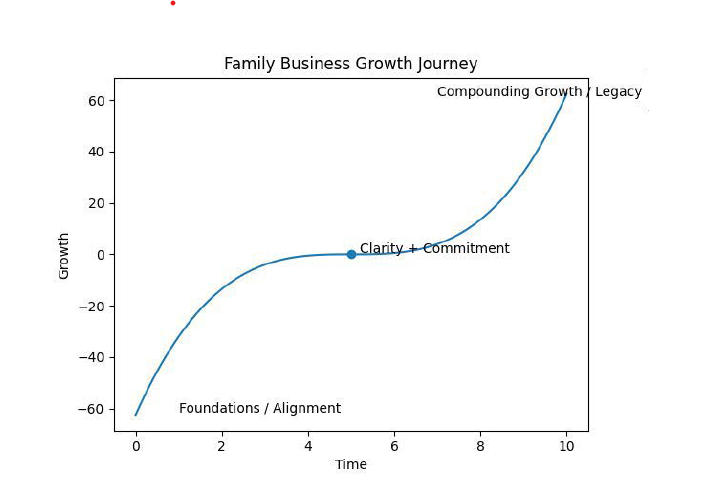
Reflection: What do you think? Are you willing to create this inflection point by getting to know your family business system better?
If so, what is the next, smallest step you can take? When can you start? Are you open to take that next step and just see what happens?
Step 2 is where CLARITY surfaces.
CLARITY creates AGENCY. Clarity creates COURAGE. Clarity creates OPTIONS to build the future you want and reduce your FEARS.
In my next article, I will explore Step 4: Get to know your family business. What is the purpose & values that you are known for, stand for? What is the legacy you wish to protect, while you and your team invest and innovate?
Stay tuned!