
Your new meeting mindset begins today!
As a small business leader, I’ve planned and sat in a lot of meetings. I’ll be honest, It wasn’t until becoming a facilitator for family businesses that I learned the essentials of running a good meeting. I had to sit through many unproductive, even dysfunctional meetings. For many of these, I was the planner and leader/ moderator. Ouch!
I get it, most would rather visit the dentist than plan the next meeting with your family or team. The image popping into your mind just now is your meeting mindset. And it’s holding you back from holding intentional, courageous meetings. What we need is a reframe of this mindset, and learn a few basic tools of what a good, safe meeting looks like (i.e. psychological safe). We also need to experience firsthand what a good meeting looks like. This is exactly what “Meeting # 2”, inside the Discovery process is designed to do.
One key tool that is guaranteed to change your meeting mindset is to follow the strategy coined by Adam Grant – “Brain Writing”. Most groupwork, ‘brainstorming’ is proven not to be effective for creativity and decision-making. We process ideas and information at a different pace. Depending on the personality, past experiences, relationship dynamics, some require time to gather their thoughts before they can share our ideas safely. This is why my meetings use this strategy, visualized so well below …
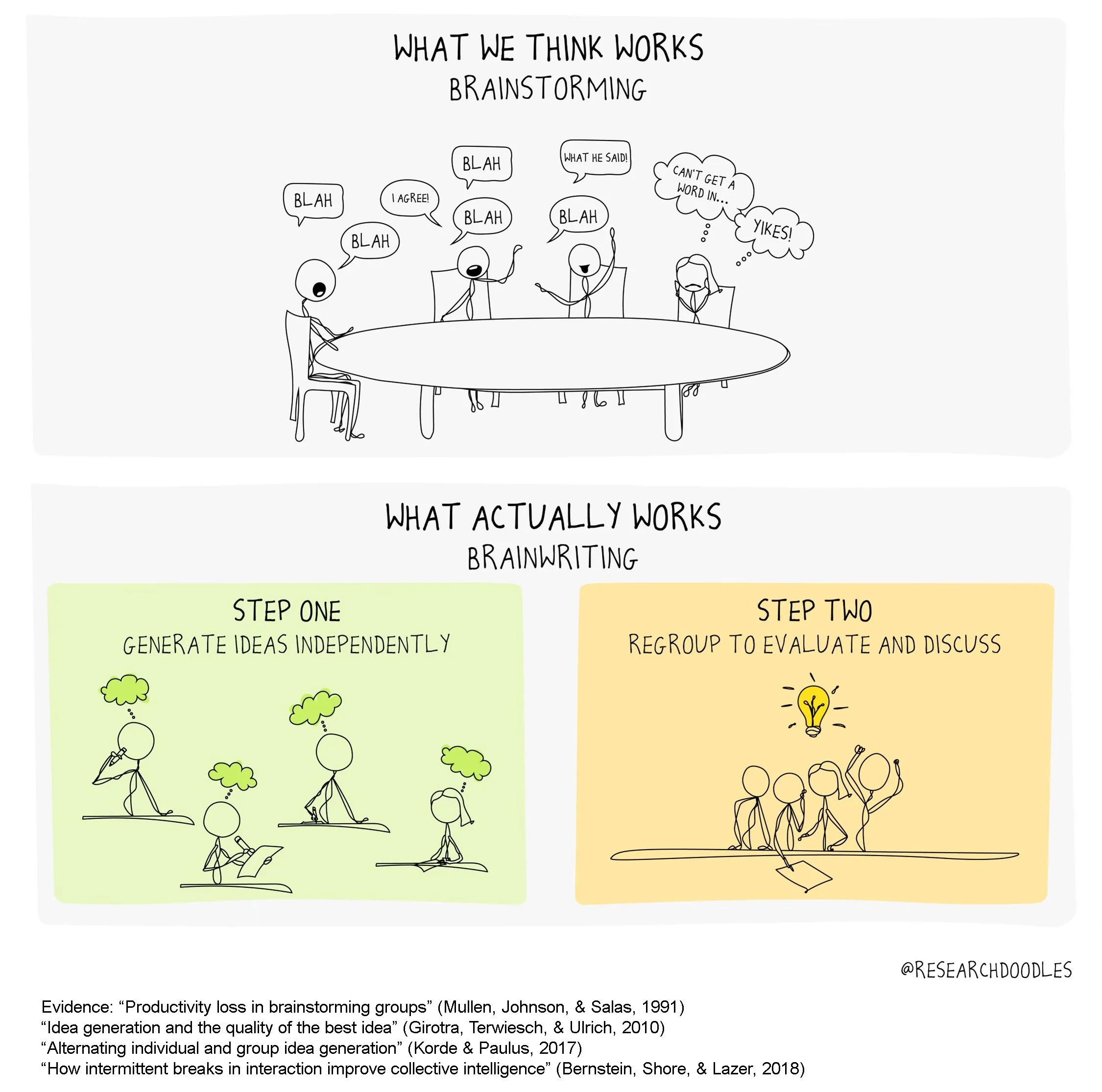
Source: Adam Grant social media.
Reflection: Have you experienced a ‘brainwriting exercise” where you gathered your ideas, thoughts individually, then collaborated as a group? If so, what was your experience? How might this compare to the usual ‘brainstorming’ experiences you’ve been part of?
Another core tool that is guaranteed to change your meeting mindset is understand that good, effective meetings do not just happen - they are designed, planned. They are intentional. I love that word, and this is a difference-maker on its own. The planning doesn’t have to take much time, and with practice, it actually becomes enjoyable. Yes, that is possible.
Here is a simple structure I use when planning meetings: Context, Content, Process. Context is king.
Context
What is the environment your team faces, and how will they show up for the meeting? Could they be distracted? How present do you think each person will be - what is on their minds? What big challenges is your family / business navigating?
Another big factor these days is the context of the world we live in right now - the economic and political uncertainty. We must appreciate that these uncertainties and fears seem heavier than normal in 2026. And each family/ team member is navigating these complexities differently - and faced with unique challenges personally too.
Content
What is the purpose of the meeting? What circles of your family business system would you like to discuss? It is best to separate meetings for each circle, due to overlapping and often competing priorities. Will it be information sharing only? Do you want to solve a problem, make a decision or start / stop a project? Do you expect that problem / decision to be solved during the meeting? Or is it a bigger problem that will take a couple of meetings to solve? Is it a project meeting, where you are looking for updates from everyone?
Process
This is where the magic happens. Yes, you can slap together agenda items, topics but they might fall flat if they are not organized well and thought out ahead of time. What activities or questions would you like to lead the group through? You do not have to be certified facilitator to think of a few questions / activities that will get the ideas flowing. How can you get everyone’s voices in the room heard early on? What light or fun way might you start the meeting with? If you aim to solve a problem, what problem-solving process do you feel will work? What processes that you’ve tried in the past haven’t worked? Why?
Let’s continue in the series exploring the six steps used to create and embrace … Structured, Intentional, Courageous Conversations.
In a previous article entitled “Getting Uncomfortable …”, I outlined what happens in the first meeting as part of the Discovery process I facilitate with family businesses. As the meeting wraps up, we go round the room to capture a word or two from everyone that expresses how they feel the meeting went. The responses vary from family to family. Some say it went better than they thought, others say, “great first step” and look forward to keeping the momentum.
One of my indicators of a successful meeting is when the family wants to meet again, and they set a date on the spot. I know, not a lofty goal on the surface, but here me out. There is no back and forth on selecting dates, or a half-interested promise to meet again. Success means you have an authentic desire from everyone in the room to meet again. This is success, one meeting at a time.
Discovery: The Second Meeting
Congratulations, your family wants to meet again and a date is set! During Meeting # 2, we recap the discussions from Meeting # 1. We also make space in the agenda to share new insights, reflections and questions.
This is intentional. Change can only happen through personal reflection.
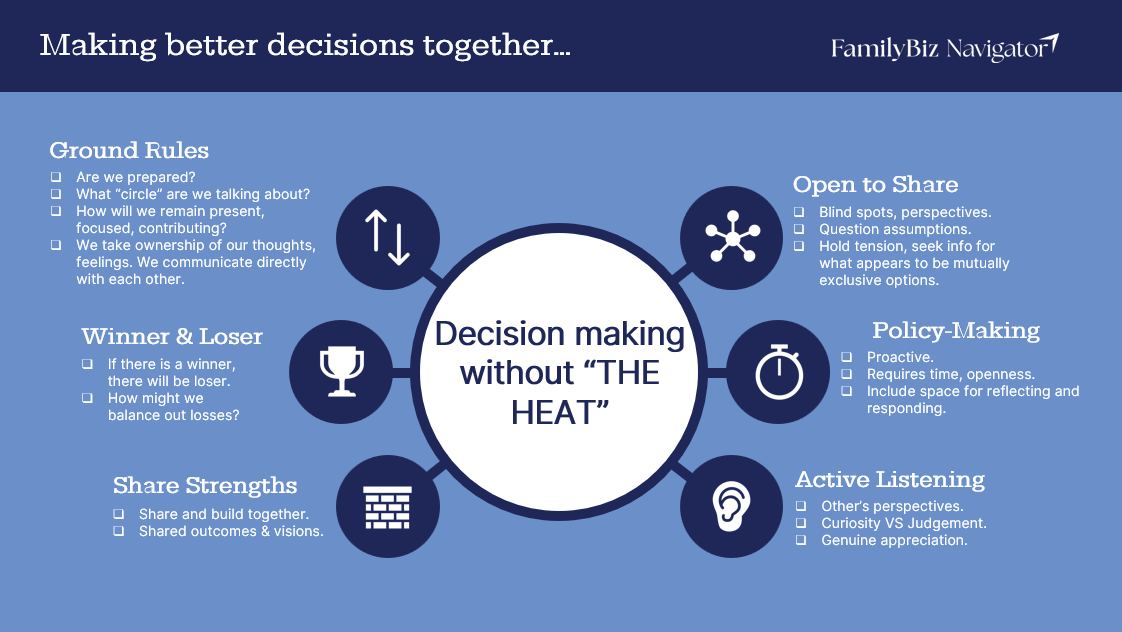
At the first meeting, or as we begin this meeting, the group creates a few Ground Rules. This is often the family’s first formal policy they create together. This is a win! This guide varies from family, but it generally includes the following:
Agenda is prepared, circulated 3-5 days in advance. We make it clear which circle we are meeting about (Family, Business, Ownership)
Cell phones turned off
Everyone listens to understand, ask questions, defer judgement
We do not interrupt each other
We go around the room to ensure everyone is heard
If an individual is getting emotional or the discussion becomes heated, anyone can ask for a short break to reset
We reserve the last few minutes to go around the room again – check-in with everyone on how the meeting went, etc.
Action items will be prepared by _______ and sent within ___ # of days
Reflection: Think about your last few meetings, even the one that went off the rails a bit. Did the group create Ground Rules such as the ones above? If not, what would that meeting look like if you had? What would have been the impact?
After the rules are set, we review the strengths and challenges of your family business system (i.e. Family, Business, Ownership areas) that were presented in the first meeting. This time, we go deeper into the strategies to help with the challenges. We openly discuss and share thoughts and questions. To prioritize this listing, the group can use a creative voting system, sticky notes or red dots on a flip chart list. This meeting design element makes things feel more equitable.
The group spends a good chunk of time during this meeting to create an Action plan to outline the selected strategies, a short description, assign champions and timelines for each.
Co-creating an Action Plan at the meeting is a differentiator … and will surely shift and reorient your meeting mindset.
Policy making – “by the family, for the family”
During this meeting, we often stumble upon a pain point or real frustration for the group. We create a policy right there that will equip them to resolve this in the future. Here is quick guide help make your next “policymaking” time productive:
Set principles and value to guide (i.e. values were set during meeting # 1)
Who is missing from this discussion, yet impacted?
Future-focused and proactive
Who will create the first draft and send to the group for input?
How will we finalize?
How often do we need to review this new policy?
Below is a graphic that includes a few of the items above that could help you plan your next meeting. A family I worked with a few years ago created the name for this and they use it for their meetings.
Reflection: So, did your “meeting mindset'“ adjust, even slightly? In what ways?
We naturally avoid what we most need to make progress on. Ask yourself: “What am I avoiding by not planning that next meeting?”
I am genuinely interested in hearing about your experiences - the good, bad and ugly! Please reach out using my contact page to connect. Trust me, I’ve heard and witnessed some real challenging meetings, especially the ones I organized and led - so you are not alone!
In my next article, we will discuss the next step in reviewing the six step process to family business continuity: Build upon what you are already doing. You are likely further ahead than you think. Stay tuned!